
In the early days of Toyota’s rise, something strange happened on the factory floor.
Workers were given permission to stop the entire production line. Not managers, not engineers — line workers. If something looked off — a vibration, a misalignment, a sound that didn’t belong — they could pull a cord and bring everything to a halt.
To Western manufacturers watching from the outside, this looked insane. Stopping production was the ultimate sin. Every minute of downtime was tracked, reported, explained, punished. Efficiency meant keeping things moving, no matter what.
Toyota did the opposite. They slowed down on purpose. And somehow, they got faster. Quality defects dropped. Rework disappeared. Costs fell. Reliability improved. What looked like inefficiency turned out to be the most efficient move they could make.
The insight wasn’t just for factories. It was about where intelligence lives. Most systems try to understand problems after they happen — through reports, dashboards, audits, post-mortems. Toyota built a system that could respond while the work was happening. They didn’t just measure reality — they acted inside it.
That distinction between knowing and doing shows up everywhere once you start looking for it. Including agriculture. Especially inside the grain bin.
Grain Storage Has Become a Reporting Exercise
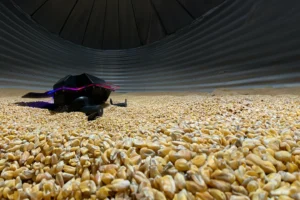
Once grain goes into a bin, something strange happens: we stop managing it. We monitor it. We measure it. We check on it. But we don’t work it.
- Temperature cables tell us something is wrong — eventually.
- Moisture readings confirm what we already suspected — too late.
- Visual inspection happens when someone decides to climb in — if they dare.
That’s not management. It’s a delayed warning system dressed up as one.
We’ve convinced ourselves that more data equals more control. But data without the ability to act is just a heads-up after the fact. By the time a bin tells you it has a problem, the problem already has momentum — crusts have formed, airflow is restricted, moisture pockets are spreading, insects have found shelter. The only options left are reactive.
We call this bin blindness: the gap between knowing a bin has a problem and being able to do anything about it before that problem gets expensive.
The Toyota Principle, Applied to Grain
Most grain storage technology today is built to observe, not intervene. But grain isn’t static — it’s a living, shifting system. Treating it as frozen in time is exactly how small issues turn into expensive ones.
Toyota figured this out decades ago. They didn’t win by counting defects better. They won by building systems that could correct themselves in real time. The same principle applies to grain: if you can’t move it, you can’t manage it.
What Is Grain Flow Intelligence?
Grain Flow Intelligence is the practice of actively managing grain inside the bin — leveling, aerating, and conditioning it in real time — instead of just monitoring it and waiting for a report to confirm a problem.
It starts with a different assumption than most storage strategies: stored grain is still part of the operation. It’s not the end of the process; it’s the final pass. That means it deserves the same intentionality and strategy as planting, harvesting, or logistics.
In practice, Grain Flow Intelligence means:
- Grain is kept level to maintain consistent airflow.
- Crusts are broken before they harden.
- Moisture pockets are disrupted instead of allowed to spread.
- Insect habitat is eliminated by movement, not chemicals.
- Sumps are cleared before unloading becomes a problem.
- Conditioning happens deliberately, not reactively.
This isn’t about fixing disasters. It’s about preventing them — early, quietly, continuously.
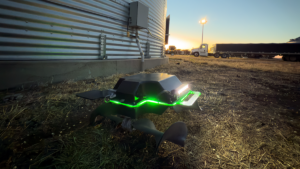
How Grain Weevil Brings Grain Flow Intelligence Into the Bin
Grain Weevil was built to give you control where control was missing: inside the bin. The robot lets you take action without ever stepping inside — and that movement is the intelligence. It works by:
- Leveling peaks so air flows evenly.
- Breaking crusts before they spread.
- Disrupting insects before they establish.
- Feeding augers cleanly instead of fighting plugged sumps.
From Storage to Strategy: What Grain Flow Intelligence Makes Possible
Once you can act inside the bin, storage stops being a holding pattern and becomes a lever. Grain Flow Intelligence lets you:
- Harvest earlier without gambling on spoilage.
- Reduce drying and cooling time by improving airflow efficiency.
- Avoid over-drying and unnecessary shrink.
- Condition grain intentionally for higher-value delivery.
- Keep bins “always level,” even after partial unloads.
- Maintain flow to load trucks faster and more safely.
Instead of hoping grain survives storage, you start designing the outcome.
Frequently Asked Questions
What is bin blindness?
Bin blindness is the gap between a grain bin telling you something’s wrong and actually being able to do something about it in time. Temperature cables and moisture sensors report problems after they’ve already gained momentum — by then, crusting, hot spots, and insect activity are already underway.
What is Grain Flow Intelligence?
Grain Flow Intelligence is an approach to grain storage that treats the bin as an active part of the operation, not a place grain sits until it’s needed. It combines leveling, crust-breaking, moisture disruption, and sump management to manage grain in real time rather than reacting to reports after the fact.
Can grain bin monitoring alone prevent spoilage?
No. Monitoring tools like temperature cables and moisture probes can tell you a problem exists, but they can’t fix it. Preventing spoilage requires the ability to act inside the bin — leveling grain, breaking crusts, and disrupting moisture pockets before they spread.
How does the Grain Weevil robot prevent insect infestations without chemicals?
It uses movement rather than pesticides. By continuously leveling and disturbing the grain surface and interior, it eliminates the still, undisturbed conditions insects need to establish habitat.